
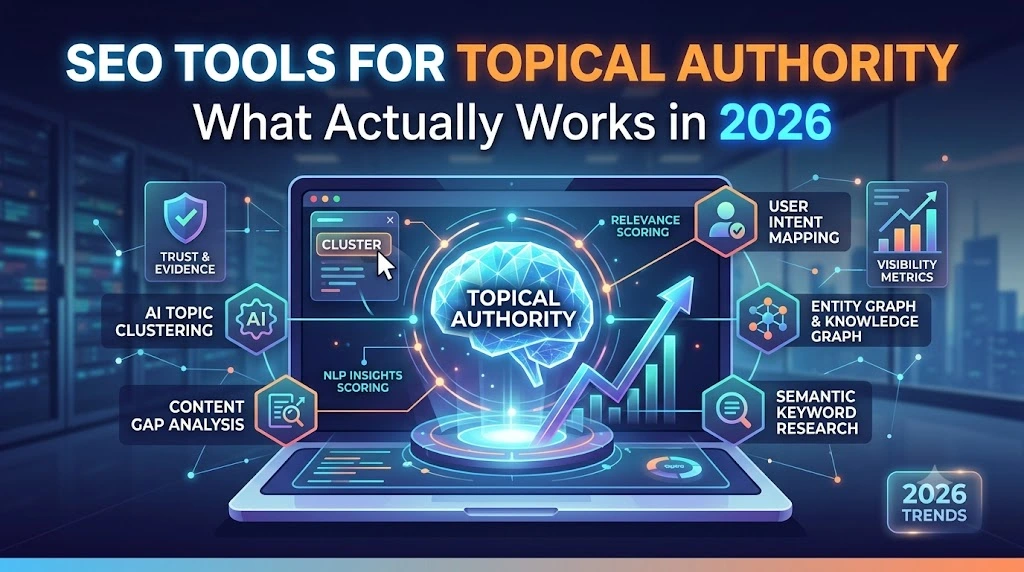
A few years ago, ranking on Google meant targeting the right keyword and getting a handful of quality backlinks. That formula has quietly expired. In 2026, search engines are evaluating something far more layered — how deeply and consistently a website covers an entire subject area. This concept, known as topical authority, is now one of the strongest signals Google uses to decide which websites it trusts enough to show prominently in search results and AI-generated answers. Websites that publish scattered content across unrelated topics are being passed over, while those that build a dense, interconnected web of knowledge around a specific niche are climbing and holding their rankings with far less volatility. The shift isn’t minor — it represents a complete change in how SEO strategy should be approached, and choosing the right tools is the first practical step toward getting it right.
Understanding What Topical Authority Tools Actually Do
Topical authority is not achieved by publishing more articles. It comes from covering every meaningful subtopic, question, and angle within your niche so thoroughly that both readers and search algorithms treat your site as the go-to source. Doing this manually is disorganized and slow — you miss gaps, you duplicate effort, and you have no clear picture of how your content connects. SEO tools built for topical authority solve this by clustering keywords semantically, identifying which subtopics you haven’t covered, and mapping out the content architecture your site needs to establish genuine subject-matter depth. Some tools go further by showing you what competing sites cover that yours doesn’t, which is arguably one of the most actionable forms of competitive intelligence available in SEO today. The best tools in this category don’t just give you a keyword list — they hand you a structured roadmap that takes the guesswork out of content planning.
A Comparison of Leading SEO Tools for Building Topical Authority
Choosing a tool depends on your workflow, budget, and the depth of analysis you need. Here is a clear breakdown of the most-used options in 2026:
| Tool | Primary Strength | Best For | Starting Price |
|---|---|---|---|
| Semrush One | AI visibility + keyword clustering | Agencies, large teams | ~$139/month |
| Ahrefs | Backlink depth + Content Explorer | Competitive research | $129/month |
| Surfer SEO | Real-time content scoring | Writers, editors | ~$89/month |
| Frase | Brief generation + SERP analysis | Content teams | ~$45/month |
| MarketMuse | Topical coverage benchmarking | Content strategy leads | Custom pricing |
| Google Search Console | First-party performance data | Every SEO, free | Free |
Each tool plays a distinct role. Semrush One and Ahrefs work best at the research and planning stage, while Surfer SEO and Frase support the actual writing process. Google Search Console remains irreplaceable because it provides real data directly from Google — no estimations, no sampling, no guesswork.
How to Use These Tools to Build a Content Cluster That Ranks
Having access to the right tools is only half the equation. The other half is using them in the correct sequence. The process starts with choosing a core topic — a specific niche or subject your site is positioned to own — and using a keyword clustering tool like Semrush or Ahrefs to pull every related question, subtopic, and long-tail variation around it. From there, you group those keywords by search intent and build a pillar page that covers the topic broadly, supported by satellite articles that each go deep on a specific subtopic. Internal linking ties the cluster together, and a good rule of practice is three to five contextual internal links per thousand words, using descriptive anchor text rather than generic phrases like “click here.” Once content is published, tools like Surfer SEO’s Topical Map feature and MarketMuse’s Content Quality Score flag which pages need improvement and which gaps still exist in your coverage. The whole system compounds over time — the more thoroughly you cover a topic, the faster new content within that topic indexes and ranks.
What Google’s E-E-A-T Standard Means for Your Content Strategy
Google’s E-E-A-T framework — which stands for Experience, Expertise, Authoritativeness, and Trustworthiness — is not a direct ranking factor, but it shapes how Google’s quality raters evaluate websites, and those evaluations influence how ranking systems are calibrated. In practical terms, E-E-A-T means your content needs to be written or reviewed by someone with genuine knowledge of the subject, cite credible sources, be kept current, and present information in a way that puts the reader’s needs first. SEO tools help you build the structural conditions for E-E-A-T — broad topic coverage, strong internal linking, and content that answers real questions — but the human layer cannot be automated. Author bios, clear publication dates, transparent editorial standards, and first-hand perspective within the writing itself all contribute to the trust signals Google looks for. In 2026, sites that combine strong topical depth with authentic expertise are not just ranking better — they are being cited directly inside AI Overviews, giving them brand visibility even on zero-click searches.
The Right Approach Going Forward
Building topical authority is not a one-time project. It is an ongoing commitment to a subject area that deepens over time. The sites gaining the most sustainable SEO traction in 2026 are not those chasing trending keywords across random topics — they are the ones that picked a lane, mapped it out completely, and keep producing content that makes that map more comprehensive with every publish. Use Semrush or Ahrefs to audit where your coverage stands today. Use Surfer SEO or Frase to make sure each new piece is optimized as you write it. Use Google Search Console weekly to spot which pages are gaining momentum and which need to be updated. Treat your content library as a living knowledge base, not a collection of individual articles, and search engines will begin to treat your site the same way — as a trusted expert worth showing to their users.
Frequently Asked Questions
What is topical authority in SEO?
It means your website is recognized by search engines as a comprehensive, trusted source on a specific subject area rather than just individual keywords.
Which SEO tool is best for topical authority?
Semrush One and Ahrefs are the most complete options, but Google Search Console is essential for everyone as a free starting point.
How long does it take to build topical authority?
Most sites begin to see measurable improvement within three to six months of consistent, well-structured content publishing around a defined topic cluster.
Does topical authority help with Google AI Overviews?
Yes — sites with strong topical depth and E-E-A-T signals are more likely to be cited as sources inside Google’s AI-generated answers.