
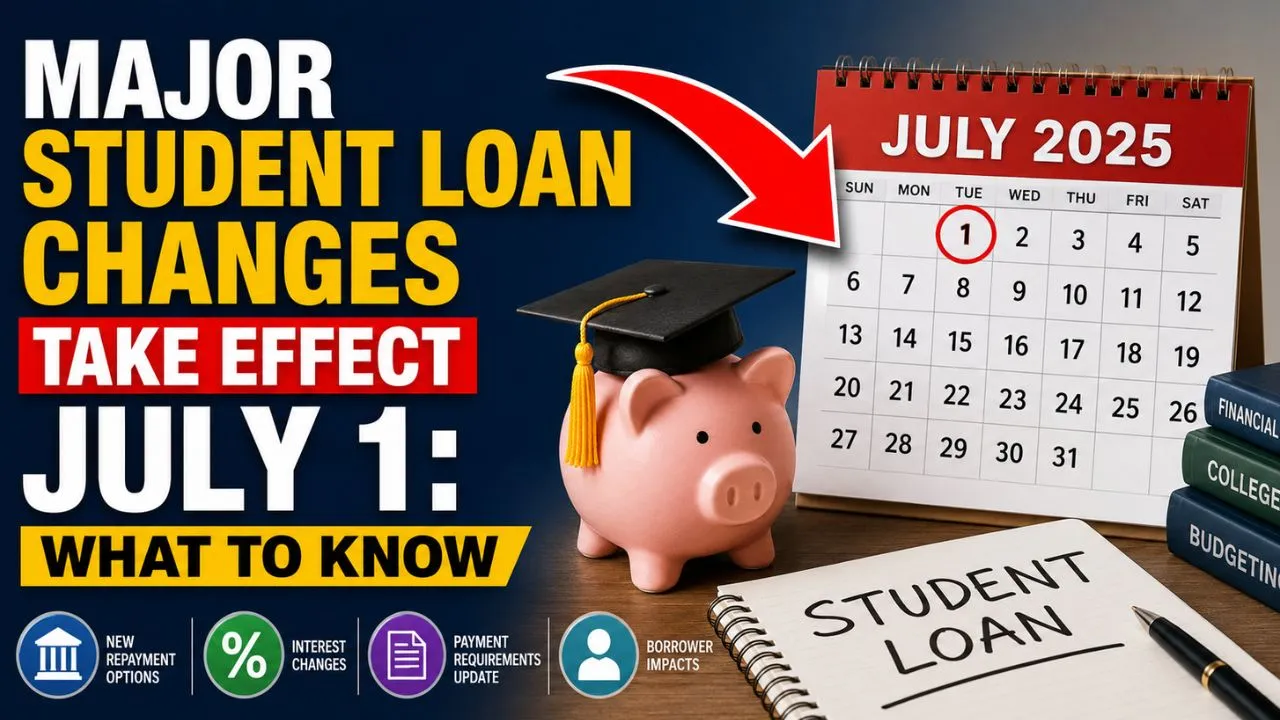
Millions of Americans wake up to a completely restructured federal student loan system starting July 1. Here is a clear, no-jargon breakdown of what has changed, who is affected, and what you should do right now.
A Landmark Shift in How America Handles Student Debt
If you carry federal student loan debt — or plan to borrow for graduate school — July 1, 2026 marks one of the most significant turning points in decades. Changes embedded in President Trump’s Working Families Tax Cuts Act, combined with executive directives targeting the Department of Education, have reshaped nearly every corner of the federal student loan system. Education Secretary Linda McMahon framed the overhaul plainly: American taxpayers should not be responsible for debts that are not theirs. The result is a leaner, stricter set of rules that replaces years of expanding income-driven options with two standardized repayment choices and firm caps on what borrowers can take out.
The scale of the system affected is enormous. Roughly 43 million Americans currently hold federal student loan debt totaling nearly $1.7 trillion. Whether you are an existing borrower scrambling to find a new repayment plan or an incoming graduate student adjusting your financial projections for the next two years, these changes touch you directly.
The SAVE Plan Is Gone — And Repayment Options Are Now Much Narrower
The most immediate disruption for current borrowers is the elimination of the Biden-era Saving on a Valuable Education (SAVE) repayment program. Approximately seven million people were enrolled in SAVE, a plan that linked monthly payments to income and household size, often resulting in very low or zero-dollar payments for lower earners. That program has been shut down, and those borrowers now have 90 days to enroll in a replacement plan or risk falling into delinquency.
Going forward, only two federal repayment paths exist for new borrowers: the Repayment Assistance Plan (RAP) and the Tiered Standard repayment plan. The Education Department argues this simplification will help borrowers understand their obligations and stay current. Critics, however, point to an important catch. The Institute for College Access and Success found that median-income households could see their monthly student loan bills jump by hundreds of dollars under RAP compared to what they paid under income-driven plans like SAVE. That is not a small adjustment for families already managing tight budgets.
New Borrowing Caps: What Graduate and Professional Students Can Now Take Out
Perhaps the most sweeping structural change involves hard limits on how much graduate and professional students can borrow through federal loan programs. Prior to July 1, borrowers could generally take out federal loans up to the full cost of tuition and fees — a flexible ceiling that reflected the wide variation in program costs across the country. That flexibility is now gone.
| Borrower Type | Annual Limit | Lifetime Cap |
|---|---|---|
| Master’s Degree Students | $20,500 | $100,000 |
| Professional Students (Law / Medicine) | $50,000 | $200,000 |
| Parent PLUS Loans | Not specified per year | $65,000 (lifetime) |
| Overall Graduate Borrowing (combined) | — | $257,500 maximum |
The administration’s stated rationale is that these caps will pressure universities to reassess their tuition pricing. Education Department Under Secretary Nicholas Kent said affordability is the defining goal: forcing institutions to compete on cost is intended to drive the overall price of graduate education down over time. Education experts are less certain the cause-and-effect will work that cleanly. Clare McCann, policy director at the Postsecondary Education and Economics Research Center, cautioned that some prospective graduate students may simply forgo their degrees rather than cover the gap through private loans or personal savings — an outcome she described as a potential overcorrection with serious implications for access to higher education.
Parent PLUS Loans and the Ripple Effect on Families
The new limits extend beyond individual graduate students. Parents who borrow through the PLUS loan program to fund a child’s undergraduate education are now subject to a $65,000 lifetime cap. For families with multiple children in college, or for those attending high-cost private institutions, this ceiling may fall well short of what they need. Families who have relied on PLUS loans to bridge the gap between grants, scholarships, and tuition invoices will need to rethink their strategies — whether that means encouraging students to consider more affordable institutions, pursuing private lending, or restructuring savings timelines entirely. The downstream pressure on household finances could be significant, particularly for middle-income families who earn too much for need-based aid but still struggle to absorb full sticker prices.
What Borrowers Should Do Before the 90-Day Window Closes
If you were enrolled in SAVE or any other repayment plan that is being phased out, your first move should be visiting StudentAid.gov and selecting one of the two new plans before the 90-day deadline expires. The Department of Education has built a repayment calculator on its website that lets you estimate your monthly bill under each option before committing. According to the department, completing the application takes roughly ten minutes. Do not wait — borrowers who miss the transition window risk entering default status, which can damage credit scores and trigger wage garnishment.
For prospective graduate students finalizing plans for the upcoming academic year, the arithmetic has changed. If your program costs more than the new annual federal limits allow, start identifying the gap now. Talk to your school’s financial aid office about institutional grants, fellowship opportunities, and employer tuition reimbursement programs before turning to private lenders, whose interest rates and terms are generally less borrower-friendly than federal loans. The earlier you map out the shortfall, the more options you will have to address it without taking on unnecessarily expensive debt.
Frequently Asked Questions
What happened to the SAVE repayment plan?
It was eliminated as of July 1, 2026; the roughly seven million borrowers enrolled in it now have 90 days to switch to either RAP or the Tiered Standard plan.
How much can a medical student borrow federally starting July 2026?
Professional students in fields like medicine and law are now capped at $50,000 per year and $200,000 over the life of their graduate borrowing.
Where do I go to switch my repayment plan?
Visit StudentAid.gov, use the built-in repayment calculator to compare your options, and complete the enrollment form — the department says it takes about ten minutes.
Will broad student loan forgiveness still happen?
No — the current administration has made clear that wide-scale forgiveness is off the table, and the Supreme Court struck down the previous forgiveness initiative in 2023.
Minnesota’s Grip of Heat and Humidity: What to Expect as Storm Season Heats Up