
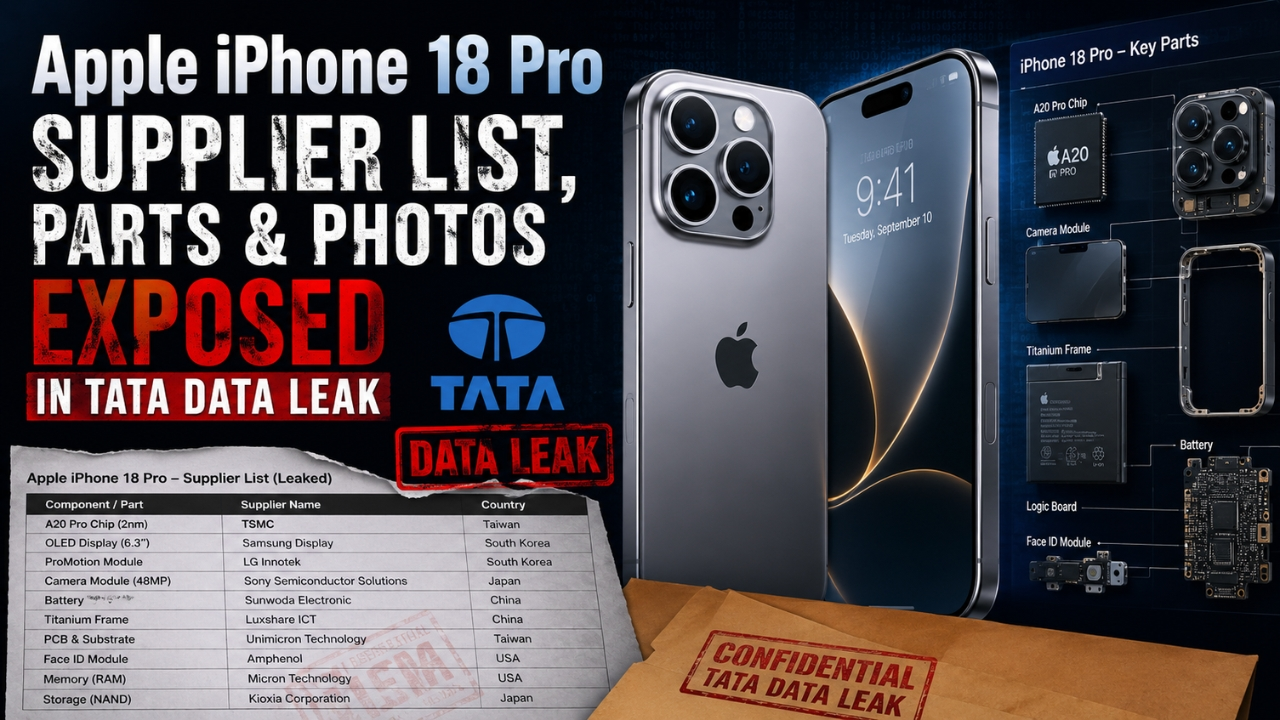
The tech world woke up to an uncomfortable reality at the end of June 2026 — one of Apple’s most closely guarded secrets had been pulled into the open. Supplier lists, internal component details, and even photographs of the yet-to-be-launched iPhone 18 Pro were circulating on the dark web, following a major cyberattack on Tata Electronics, Apple’s key manufacturing partner in India. This was not a rumour planted by a case maker in Shenzhen. It was a structured, documented breach affecting hundreds of thousands of files and striking at the very heart of how Apple builds its most important product.
Who Is Behind the Attack and What Was Stolen
The group responsible calls itself World Leaks — a ransomware collective that operates not by encrypting your files and demanding a decryption fee, but by stealing data outright and threatening to publish it unless paid. On June 12, 2026, the group announced on its dark web site that it had taken more than 204,300 files from Tata Electronics, totalling over 630 gigabytes of sensitive information. World Leaks is not a new player. It emerged in 2025 after rebranding from a previous ransomware operation known as Hunters International, following increased law-enforcement pressure that pushed the group to abandon encryption-based attacks entirely in favour of pure data theft and extortion.
What makes this breach different from most is the quality of data involved. Among the files are at least six documents that map individual iPhone 18 Pro components — including chips on the main logic board, battery parts, and camera hardware — directly to the specific vendors supplying them. Apple guards this kind of information with near-obsessive secrecy and does not include supplier-to-component mappings in its public supplier database. The exposure hands rivals, counterfeiters, and even Apple’s own vendors a detailed picture of exactly who makes what and how dependent Apple is on each of those relationships.
What the Leaked Files Actually Reveal
The leaked archive contains several layers of sensitive material, and they are worth understanding separately. There are the obvious headline-grabbers: photographs of what sources told Reuters are iPhone 18 Pro handsets undergoing drop tests at a Tata facility in early 2026. The devices pictured are flat, grey slabs with a three-camera rear array and the Apple logo on the back — consistent with widely expected design directions for the lineup. Some of the files also carry internal Apple “confidential” watermarks and project codenames tied to the iPhone 18 generation.
But the more strategically damaging material is the supplier mapping itself. These documents reveal not just who supplies a given part, but also where Apple sources the same component from multiple vendors — preserving its negotiating leverage — versus where it relies on a single supplier, making it more vulnerable. That kind of information is immensely valuable to competitors, who can now identify Apple’s pressure points, and to other vendors, who can use it to restructure their own contract negotiations. Paolo Pescatore, founder of PP Foresight, described the exposure as giving outsiders “a rare glimpse into how Apple’s supply chain is structured and where it may be exposed.”
The table below summarises the key facts of the breach as currently known:
| Detail | Information |
|---|---|
| Breach announced | June 12, 2026 |
| Attacker | World Leaks ransomware group |
| Files exposed | 204,300+ files |
| Data volume | ~630 GB |
| Tata acknowledgement | June 22, 2026 |
| Key data types | Supplier maps, component lists, drop-test photos |
| Target product | iPhone 18 Pro (expected launch: September 2026) |
| India’s iPhone share (2026) | ~26% of global production |
Why Tata Electronics Was a High-Value Target
Tata Electronics is not a marginal subcontractor. It is one of Apple’s two primary assemblers of iPhones in India — alongside Foxconn — and currently accounts for roughly a third of Apple’s total iPhone production in the country. India itself is on track to manufacture around 26% of all iPhones made worldwide in 2026, a steep climb from just 6% four years ago. That growth is a cornerstone of Prime Minister Narendra Modi’s push to position India as a global electronics manufacturing powerhouse, and it has made Tata Electronics one of the most strategically important companies in Apple’s entire global supply chain.
That elevated role, however, also means that enormous volumes of proprietary Apple manufacturing data sit on Tata’s systems as a routine matter. You cannot assemble an iPhone without possessing detailed documentation about its internals. That is what makes a supplier breach so uniquely damaging compared to a conventional corporate hack — the data accessed is not incidental, it is the data of record. Cybersecurity researcher Rajshekhar Rajaharia pointed out that Tata’s growing role within Apple’s ecosystem means “more of Apple’s sensitive manufacturing data now sit with one partner,” and that partner just suffered one of the largest verified breaches in Indian electronics history.
Apple, Tata, and the Trust That Now Hangs in the Balance
For both companies, the breach does damage well beyond the technical. Apple has spent years building a reputation for product secrecy so airtight that even its own retail employees often do not know what a new device looks like until launch day. That culture of control now faces its sharpest test yet, because the exposure did not come from inside Apple’s own walls — it came from a trusted partner. This is precisely the challenge of modern supply-chain cybersecurity: your own defences are only as strong as the least-secure organisation that has legitimate access to your data.
Apple has confirmed it is investigating the incident and working with Tata on additional security measures. Tata has restricted internal access and brought in external forensic consultants to review what happened. Neither company has commented on the specific documents cited in media reports, and Reuters stated it was unable to independently verify the full authenticity of every file in the leaked cache. What is confirmed, though, is that the breach occurred, that Tata acknowledged it, and that Apple considers the leaked information sensitive. The timing adds further difficulty: Apple recently raised iPad and MacBook prices due to surging memory and chip costs driven by global AI infrastructure demand, and analysts widely expect iPhone 18 pricing to follow suit. A supply-chain scandal sits uncomfortably alongside a product cycle that will already attract scrutiny.
The broader lesson here is one the entire technology industry needs to absorb. No organisation, however large or disciplined, can fully secure data that must exist in dozens of partner environments to make its products possible. The iPhone 18 Pro breach is a reminder that modern manufacturing is not just a logistical challenge — it is a cybersecurity challenge, and the two can no longer be treated separately.
FAQs
What did the Tata Electronics data breach expose?
Supplier lists, component details, and drop-test photos of the unreleased iPhone 18 Pro were leaked on the dark web.
Who is responsible for the Tata data breach?
A ransomware group called World Leaks claimed responsibility after stealing over 630GB of files from Tata Electronics.
Will the iPhone 18 Pro launch still happen in September 2026?
Yes, Apple is expected to proceed with its planned September 2026 launch despite the breach.
Is Tata Electronics a major Apple supplier?
Yes — Tata currently assembles roughly one-third of Apple’s iPhones manufactured in India.
Future-Proof Your Career in 2026: Why You Should Focus on What AI Can’t Do